Custom kids joinery vs IKEA Dubai: what fits a child's room
Short answer: flat-pack wins when you rent, when the whole room has to land under a few thousand dirhams, or when the child is under three and the layout gets rebuilt anyway. Fitted kids joinery wins when the room has a bulkhead, an odd corner or a shared-room brief, and when one build has to serve from age four to fourteen. The room decides, not the brand.
Start with the room, not the brand
Two bedrooms a kilometre apart are rarely the same job.
A JVC apartment bedroom is often a 2.6m to 3m box with one window, a wardrobe wall that loses 30cm to an a/c bulkhead at ceiling level, and skirting that runs out of level in one corner. A villa bedroom on Palm Jumeirah usually gives three clear walls, more depth, and a sloped ceiling on the upper floor.
That geometry decides more than budget does. In the JVC room, a 60cm flat-pack wardrobe standing against the bulkhead leaves a gap above it that nobody can reach and everybody can see. A fitted run that stops under the bulkhead and closes to the ceiling gives storage back in a room that has none to spare. In the Palm villa, flat-pack can last for years because you can move it around.
One measurement habit worth copying before you buy anything: measure at the skirting and again at one metre. Dubai apartment walls are rarely square or plumb, and a 3cm bow shows up the day a carcass will not sit flush.
Where flat-pack genuinely wins
Renting, or a one to two year horizon. A bunk anchored into a landlord's wall is money you leave behind, and the next tenant may not want the holes.
A budget under a few thousand dirhams for the entire room. A fitted build is not a like-for-like swap at that number, and pretending otherwise wastes your time.
Storage that has to move between rooms or apartments. Bespoke is built for one wall, in one room, to one millimetre.
A child under three. The layout gets rebuilt at four: the cot goes, a floor bed arrives, the low shelf becomes a desk. Buying fixed joinery now usually means buying twice, unless you spec it to be re-fitted later.
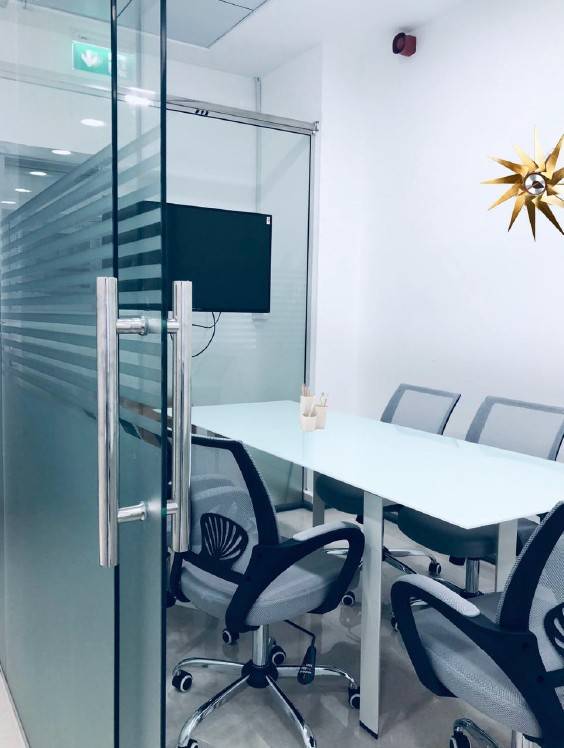 A meeting room we handed over in Business Bay. The glass, framing and surrounding joinery come off the same workshop drawings as a kids room run.
Where bespoke kids furniture in Dubai wins
The flat pack vs custom furniture question in Dubai usually lands on four situations.
Odd geometry first. A bulkhead, a structural column, a window sill at 40cm, a corner that measures 87 degrees. Flat-pack needs a rectangle. A workshop does not.
Shared rooms second. Two children in one room usually need a bed, a wardrobe and a desk on a single run, and flat-pack modules fight each other for the same three metres. Fitted kids room joinery puts the desk under the window, the wardrobe at the door end and the bunk over the desk, all set out from one datum.
Then dust. Open tops and the 10cm gap behind a carcass collect it, and in an air-conditioned room that dust sits on a cold surface. Closing to the ceiling and scribing the ends into the wall removes the ledge.
And the structures flat-pack does not make: a loft bed with stairs rather than a ladder, drawers built into bunk risers, a study nook inside a window reveal. This is our normal work, and past builds are in our kids joinery guides and projects.
"The quality of the fit-out and joinery work was very good, and they paid attention to our requirements" anil kumar, 5 stars
Our Google rating sits at 5 from 8 reviews.
The safety difference that matters most: wall anchoring
Every wardrobe and bunk sold in the UAE ships with a wall strap. Most never get fitted, and the strap is not the real issue anyway.
A 1.8m wardrobe with a full drawer pulled out is top heavy, and a five year old climbing the drawers is a lever. In a Dubai apartment, kids bedroom joinery usually lands against a 100mm gypsum partition on metal studs, where a plaster plug pulls out under load.
Bespoke should be mechanically fixed, not strapped. Fixings chosen for the substrate: masonry anchors into blockwork or concrete, a plywood pattress or the located studs where the wall is drywall, and tall units fixed at the top rail as well as the base. Put it in writing on the drawing, with the anchor type named. A supplier who has not identified what the wall is made of before quoting has not surveyed the room.
Worth adding to the same document: anti-tip brackets on every drawer stack over 60cm, no gap between the bunk rail and the mattress that a limb can pass through, and eased edges on anything below waist height.
Materials, humidity and the maths behind the price
Chipboard, MR MDF, plywood
Flat-pack carcasses are chipboard, usually 16mm, with a melamine face. Fine in a dry room, unforgiving of a leaking water bottle, because a swollen cut edge never goes back. Moisture-resistant MDF takes paint better and holds a profile. Plywood is strongest at the joints and dearest. For a kids room the sensible spec is MR MDF or plywood carcasses with painted or laminated fronts, and edge banding at 2mm rather than 0.4mm, which lifts within a year of daily use.
Finish and ventilation
Ask for low-VOC paint or lacquer, and ask whether the finish is tested to EN 71-3, the toy safety standard for heavy metal migration. Children put their mouths on furniture.
A closed carcass against an external wall needs a service gap and vents. Seal it tight and the back panel becomes the coldest surface in an air-conditioned room, which is where condensation and mould start.
Comparing the two without inventing numbers
Do not compare purchase prices. Compare cost per year of use to age fourteen. Count the flat-pack sets you will buy in that window, then add delivery, assembly and the cost of getting rid of the old ones. Do the same for one fitted build plus two re-fits: raise the rail, swap the desk top, add a shelf.
Then ask both suppliers for identical line items, so the totals mean something. The wardrobe half of this maths, including material grades and what safety extras add, is broken down in custom kids wardrobe costs, materials and safety.
| Ask both suppliers | Why it changes the number |
|---|---|
| Substrate and fixing method | Masonry anchors and a pattress are extra work, and the difference between a safe tall unit and a strap |
| Material and thickness | 16mm chipboard, 18mm MR MDF and plywood price differently, and so do the joints |
| Hardware brand and rating | Runners and hinges fail first, and get cut first from a cheap quote |
| A physical finish sample | Matching an existing door or floor happens at sample stage, not on site |
| Lead time by stage | Survey, drawing approval, workshop and install are separate dates. Ask for all four |
| Site protection and waste removal | Floor protection, dust sheets and skip hire are real costs, often quietly excluded |
| Payment milestones | A schedule tied to delivered stages protects you. A large deposit up front protects them |
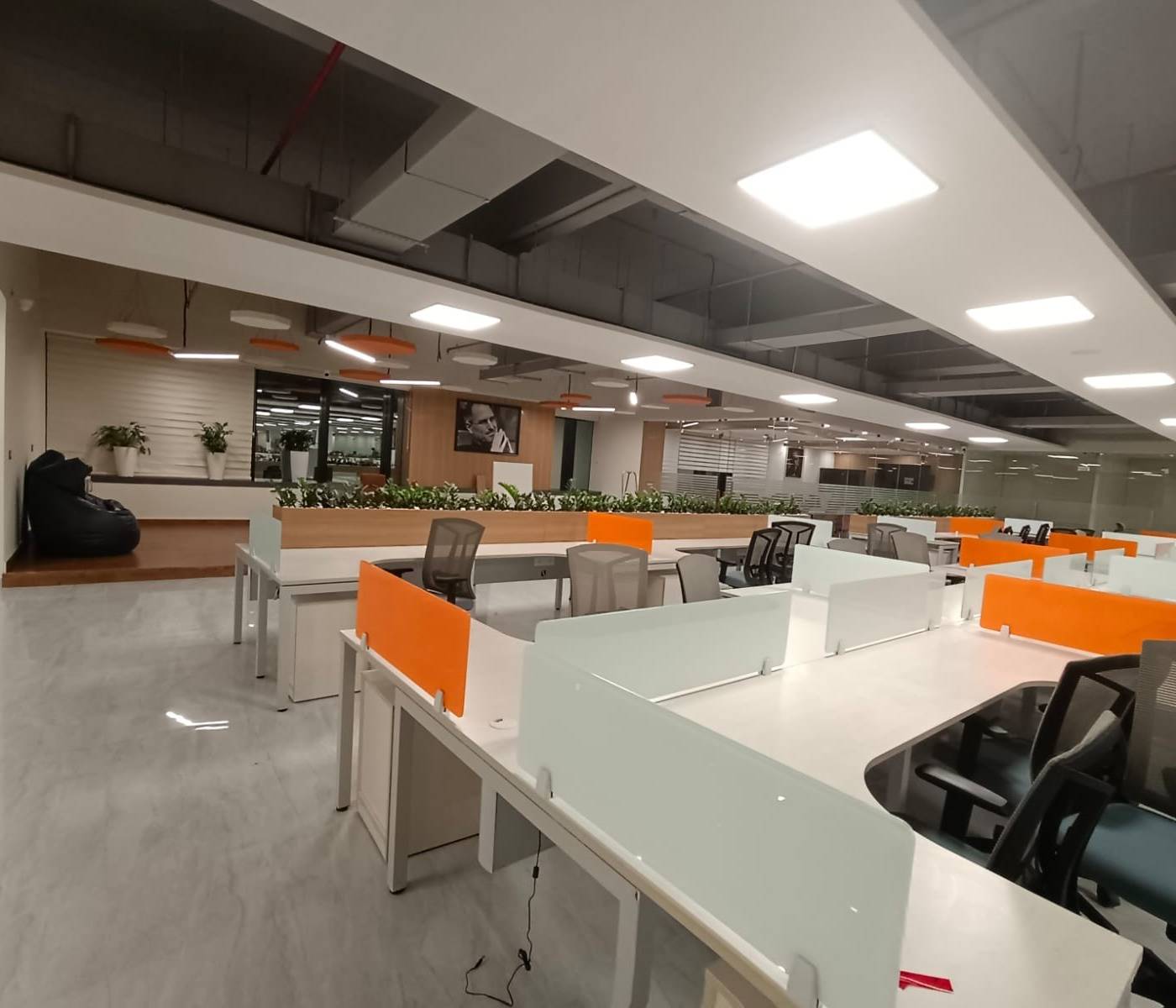 Same discipline as a bedroom: worktops, panels and edges set out from one datum. Open-plan office, Dubai.
To price your room, send three photos of each wall with the door open and the window closed, the internal length and width in centimetres, the ceiling height, and the building name and area. For a Palm Jumeirah villa, add one photo of the sloped ceiling or the bulkhead. WhatsApp is the fastest way to get it looked at: +971 55 379 6441. You can also get a measured kids joinery quote from the contact page.
Frequently asked questions
Is custom joinery worth it for a kids room?
It is worth it when the room is awkward or your child will stay in it for more than three or four years. On a plain rectangular wall with a two year horizon, flat-pack does the same job for less. The deciding factor is how many times you expect to replace the furniture before your child turns fourteen.
Can bespoke kids joinery be moved later?
Sometimes. Built as separate screwed modules rather than one glued box, a run can be dismantled and re-fitted in another room, usually with new end panels and a new scribe. Anything anchored into masonry leaves holes that need patching, and a top rail cut for one ceiling height will not fit another.
How long does it take?
Ask both suppliers for four dates in writing: survey, drawing approval, workshop completion, installation. Installation is normally the shortest stage. Approval is where jobs lose weeks, especially where building management or a landlord has to see drawings before work starts.
Does fitted joinery damage the wall?
It puts holes in it. Scribing hides the gaps, and fixings leave plugs that are patched and repainted at handover. On a gypsum partition the pattress stays inside the wall, which is worth mentioning to a landlord before you start.
Is it safe for toddlers?
Safety comes from the fixing and the details, not the material name. Every tall unit fixed at the top, no climbable drawer stack without anti-tip brackets, gaps closed so a limb cannot pass through, and a finish with low VOC. Keep loft beds and top bunks for older children.