Shared kids room joinery Dubai: layouts that work for two or three children
Shared kids room joinery in Dubai is how you give two or three children their own bed, wardrobe and desk without halving one bedroom into two cramped spaces. Here is the space planning maths, three layout patterns, the safety and fairness rules, and a real AED cost example for a 3.5m by 4m room.
Why work with Noor al Sundus
- Kids joinery only, every project is a child's bedroom
- In-house design and production team
- Own joinery workshop in Jebel Ali
- Serves Palm Jumeirah, JVC and Dubai
- Fixed itemised quotes before production starts
- Google rating of 5 from 8 reviews
Shared bedrooms are normal in Dubai, so start with the maths
Most Dubai two bedroom apartments and plenty of Palm Jumeirah villas end up with two children in one room, and usable floor per child often lands under 6 sqm. That works, but only if the joinery is planned around numbers rather than around a shop bought bed.
For a 3.5m by 4m room, budget these footprints:
- Single bed with under bed drawers: 1000mm by 2000mm mattress, 1100mm by 2100mm overall
- Bunk bed: 1100mm by 2100mm overall, plus 600mm for the stair drawer unit
- Wardrobe: 600mm deep, 1200mm wide per child for hanging plus drawers
- Desk: 1100mm by 550mm per child, or one 1600mm shared desk
- Walkway: 700mm minimum between a bed edge and a wardrobe front
- Door swing and window clearance: 800mm clear
The rule of thumb we use across our kids joinery Dubai work is 5.5 to 6.5 sqm per child, including their share of the walkway. Below 5 sqm each, stop planning side by side and start planning upward.
Three layout patterns for shared bedroom joinery Dubai
Side by side bunks with a shared stair drawer unit
Suits ages 3 to 8 and rooms from 12 sqm. The bunk runs along the longest wall and the stair unit doubles as a drawer tower, usually three or four steps holding about 0.25 cubic metres. Each child gets a shelf and a reading light at the head of their own bunk.
L shaped twin beds with a full height divider
Best when the age gap is 2 to 4 years and the children are 8 or older, because they want privacy more than floor space. Beds run along two walls and a divider 1400mm to 1600mm tall sits between them, with shelving facing each side. Take the divider to 2000mm when one child studies while the other sleeps.
Bunk plus desk tower
For gaps of 5 years or more, or for rooms under 12 sqm. One child takes the upper bunk, the other sleeps low, and the vertical tower carries a desk, drawers and a wardrobe on the footprint of a single bed.
| Age gap | Best pattern | Minimum room |
|---|---|---|
| Under 2 years | Side by side bunks | 12 sqm |
| 2 to 4 years | L shaped twins with divider | 13 sqm |
| 5 years or more | Bunk plus desk tower | 10 sqm |
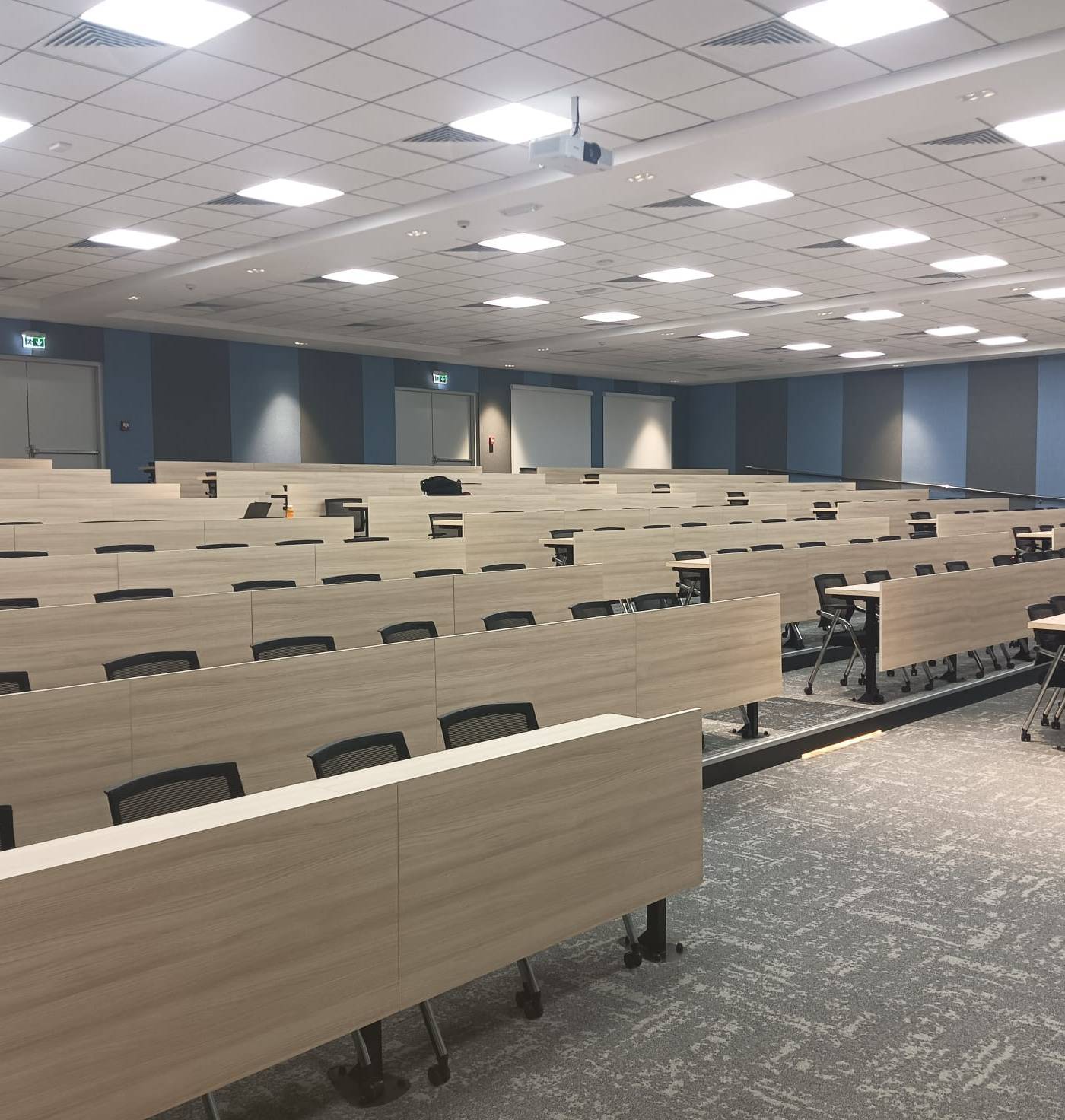
Rows of light wood desks and black chairs in a completed lecture hall, produced and installed by the same joinery team.
Safety and fairness rules for room divider joinery kids Dubai
Safety comes down to four things: how the unit is fixed to the wall, what the board and finish emit, how wide the gaps are, and what kind of lock you use. Get those right and a divider becomes the safest way to split a room.
- Anti tip fixing: every tall unit anchored into masonry or studs with 8mm bolts, never into plasterboard alone
- Board: 18mm MDF or plywood to an ESMA aligned low emission grade, cut and edge banded in the workshop
- Finish: water based low VOC lacquer, with 5 to 7 days cure before the room is slept in
- Gaps: no opening between 60mm and 230mm where a child can reach
- Edges: 2mm radius minimum on all exposed edges at bunk level
- Locks: magnetic or push latches only, no key locks on a child's wardrobe
- Handles: nothing that can act as a step above 1200mm
- Ventilation: a 50mm gap or a vent panel behind bunk nooks
Fairness matters as much as safety. Match drawer counts, shelf heights and mattress sizes between children. Children count drawers.
Storage that stops the fights
Give each child a personal locker at their own height and keep shared items above. That one rule removes most of the daily arguments in a shared bedroom.
- Personal locker: 500mm wide by 400mm tall, set 400mm to 900mm off the floor
- Labels: name or colour coding at 1000mm to 1200mm, roughly eye level for a 6 to 10 year old
- Toy storage: deep drawers between 400mm and 700mm, nothing heavy above 1400mm
- Wardrobes: one per child, with an identical internal layout, see custom kids wardrobe Dubai
- Shared items: spare bedding and board games in top boxes, out of reach
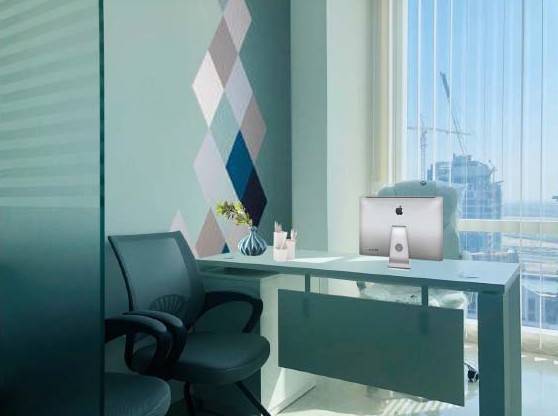
A finished workstation run against a teal feature wall, the same panel and desk build used in shared room study towers.
What shared kids room joinery costs in Dubai
For a 3.5m by 4m room in Palm Jumeirah for two children, one aged 5 and one aged 9, the joinery package lands between AED 18,000 and AED 32,000 installed.
- Two single beds with drawer bases: AED 6,000 to 11,000
- Two full height wardrobes at 1200mm wide: AED 6,000 to 11,000
- One shared desk at 1600mm with two pedestals: AED 2,500 to 5,000
- One divider with shelving on both sides: AED 3,000 to 5,500
What moves the number: laminate or veneer, soft close runners, LED nooks, curved edges, and access. A laminate scheme sits at the lower end, while veneer, lacquer and curves push toward AED 32,000. In JVC most apartment jobs go straight up in the service lift, while Palm Jumeirah villa work often adds protection and lift booking time.
For bed only pricing, see bespoke kids bed costs in Dubai.
I would like to share my very positive experience with Noor Al Sundus Contracting Munawwar Ali Khan, 5/5
Timeline from measure to handover
- Site measure and design, 2 to 3 weeks. Room survey, two layout options, board and laminate samples, then written approval.
- Production, 3 to 4 weeks. Everything is cut, edge banded and finished in our kids joinery workshop in Dubai, so nothing is assembled from flat pack on site.
- Installation, 2 to 3 days. Dust sheets, wall fixing, alignment of doors and drawers, then a full clean up.
- Snag walk within 7 days of handover, so any adjustment is logged while the job is fresh.
professional, responsive, and cooperative throughout the project anil kumar, 5/5
Frequently asked questions
How much does shared kids room joinery cost in Dubai?
For a 3.5m by 4m room with two bed bases, two wardrobes, one shared desk and a divider, budget AED 18,000 to 32,000 installed. Laminate finishes sit at the lower end of that range and veneer with lacquer sits at the top. A single bunk with a desk tower for a smaller room can start nearer AED 12,000.
Can two children share a 3m by 3m room?
Yes, but only with vertical joinery. A bunk with a stair drawer unit plus one shared wardrobe will fit with a 700mm walkway, while two separate beds and two wardrobes will not. Anything under 5 sqm of floor per child has to go upward.
What age gap works best for bunks in a shared room?
Bunks suit ages 3 to 8, and the upper bunk should not be used at all below 3. With a gap of 2 to 4 years and children over 8, an L shaped layout with a divider gives more privacy. Gaps of 5 years or more work well with a bunk plus desk tower.
How long does custom kids joinery take in Dubai?
Design and approval takes 2 to 3 weeks, production takes 3 to 4 weeks, and installation takes 2 to 3 days. From deposit to handover the usual window is 6 to 8 weeks. Add about a week if you choose a bespoke veneer or curved panels.
Is a divider between two children safe?
Yes, if it is fixed to the wall and floor, has no climbable handles and avoids gaps between 60mm and 230mm. Keep the divider at 1400mm to 1600mm for children under 10 so it does not double as a climbing frame.
Do you install in Palm Jumeirah and JVC?
Yes, the team works across Palm Jumeirah, JVC and Dubai. Everything is produced in the Jebel Ali workshop and installed in one visit of 2 to 3 days. Villa jobs in Palm Jumeirah usually need a lift booking, while JVC apartment jobs are quicker to access.